
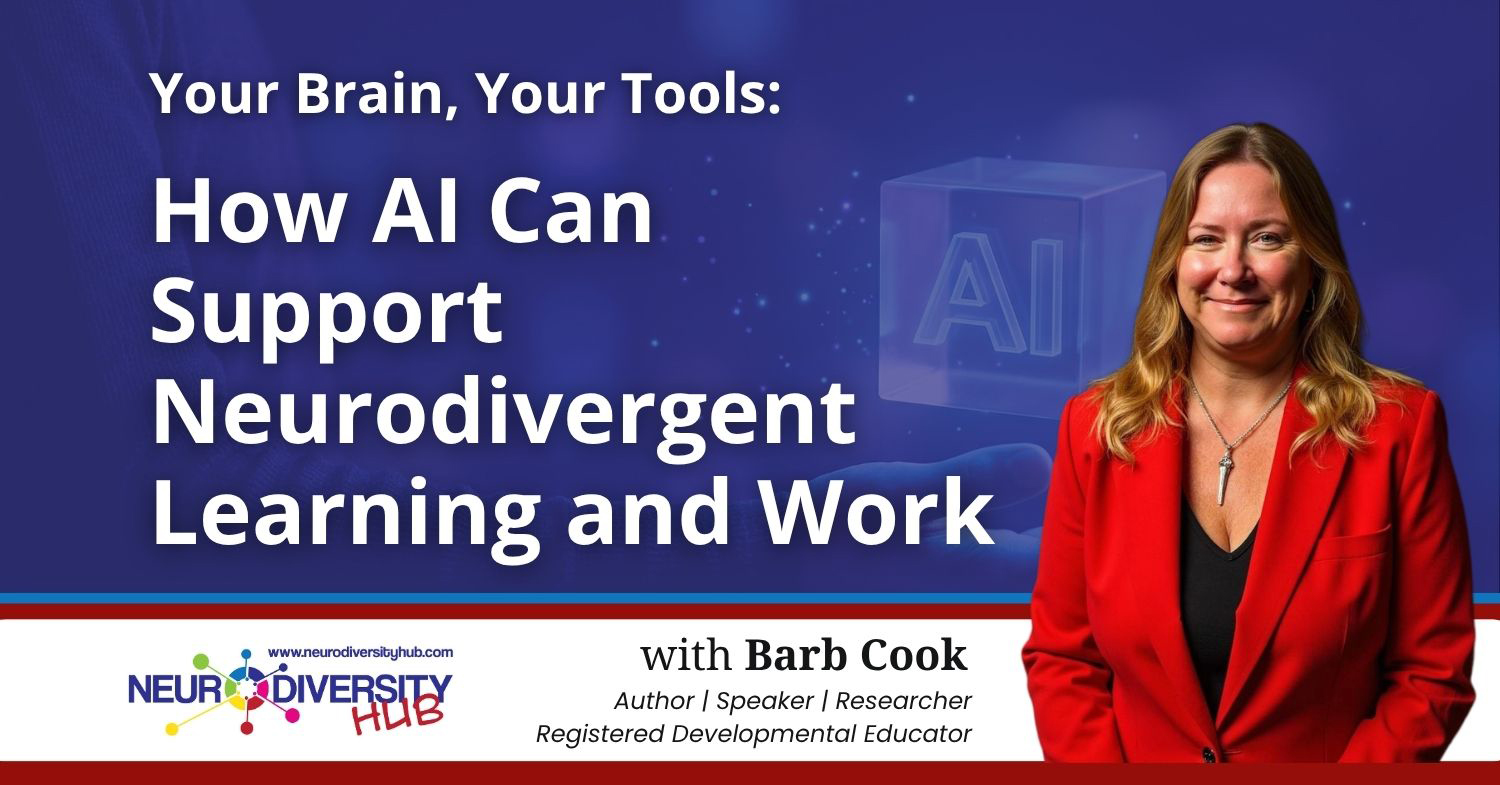
Your Brain, Your Tools: How AI Can Support Neurodivergent Learning and Work
About this course
A Certificate of Completion for 1.5 hours professional development will be available for you to download upon completion of this course.
Your Brain, Your Tools: How AI Can Support Neurodivergent Learning and Work
AI is everywhere right now. But almost no one is asking the right question: does it actually work with a neurodivergent brain?
This course cuts through the hype.
For neurodivergent people, the promise of AI can feel exciting and overwhelming in equal measure. New tools, new demands, new ways to feel like you're falling behind. And for the teachers, trainers, and support professionals trying to figure out how to use AI responsibly, the questions keep multiplying.
This session brings both perspectives into the same room.
Barb Cook, Registered Developmental Educator, researcher, and neurodivergent person, explores where AI genuinely supports neurodivergent learning and work, where it can quietly make things harder, and what it takes to use these tools in ways that actually fit the brain doing the work.
What This Course Covers
- How executive functioning differences shape the way neurodivergent people experience learning, work, and technology
- Where AI can genuinely help: task initiation, working memory, communication support, reducing the masking tax, and more
- Where AI can get in the way: cognitive overload, over-reliance, the confidence gap, and inequity of access
- What teachers and trainers need to know about designing for neurodivergent learners from the start, not as an afterthought
- Teaching intentional AI use rather than instinctive use
- Rethinking assessment in an AI world as an equity issue for neurodivergent learners
- Building psychological safety around tool use and help-seeking in education and workplace settings
- What support workers, job coaches, and allied health professionals need to consider as AI becomes part of daily life
- A practical, non-overwhelming guide to AI tools neurodivergent people actually find useful
Who This Course Is For
- Neurodivergent people wanting to understand how AI can genuinely support them
- Parents, caregivers, and families
- Teachers, educators, and education support staff
- Allied health professionals, support workers, and job coaches
- Employers and HR professionals working toward neuroaffirming workplaces
- Anyone curious about the intersection of AI and neurodivergent minds
What You Will Gain
- A clear, honest picture of what AI can and cannot do for neurodivergent brains
- Practical strategies for using AI in ways that reduce load rather than add to it
- Language and frameworks to support neurodivergent people to use technology with agency and confidence
- Insight into the equity dimensions of AI in education and work
- A starting point for building neuroaffirming AI practices at home, in education, and in the workplace
This course will provide practical tools, tips and strategies for teachers, educators, employers, job coaches, parents, allied health professionals, support workers and carers.
This course may be claimable for Self & Plan Managed NDIS Participants. Please check with your plan manager/LAC.
Course curriculum
-
-
Your Brain, Your Tools: How AI Can Support Neurodivergent Learning and Work
-
Presentation Slides
-
Recommended Readings (Books)
-
Website Links
-

About this course
- $45.00
- 1.5 hours of video content
- Certificate of Completion for 1.5 Hours Professional Development
- 60 Days to complete course
Grow your knowledge, starting today
Additional Courses
-

Bright and Struggling: Understanding the 2e (Twice Exceptional) Neurodivergent Learner
CourseThey're clearly bright, yet falling apart at school. Discover why twice exceptional (2e) learners are so often missed, how high ability can mask real struggle, and practical, neuroaffirming strategies that actually help at home and school.
Purchase$45
-

Executive Functioning Is Not Motivation
CourseThis course reframes executive functioning through a neuroaffirming lens, exploring capacity, energy, regulation, and practical supports for autistic, AuDHD and ADHD people of all ages, families, teachers and professionals.
$45
-

Autism/ADHD PDA & School Understanding Demand Avoidance and Learning
CourseLearn how teachers and educators can support students with PDA using neuroaffirming, practical strategies that build autonomy, regulation, and engagement in inclusive classrooms.
$69
-

Autism & ADHD Understanding Sensory Environment in School
CourseLearn how to create sensory-aware, inclusive classrooms for autistic and ADHD students. This neuroaffirming course gives teachers practical, person-centred strategies to support attention, regulation, and learning in school environments.
$69
-

RSD in School: Understanding Rejection Sensitivity and Intense Emotions
CourseFor teachers and school staff: understand why some students experience everyday classroom interactions so intensely, and how small shifts in communication and relational safety can change everything.
$55
-
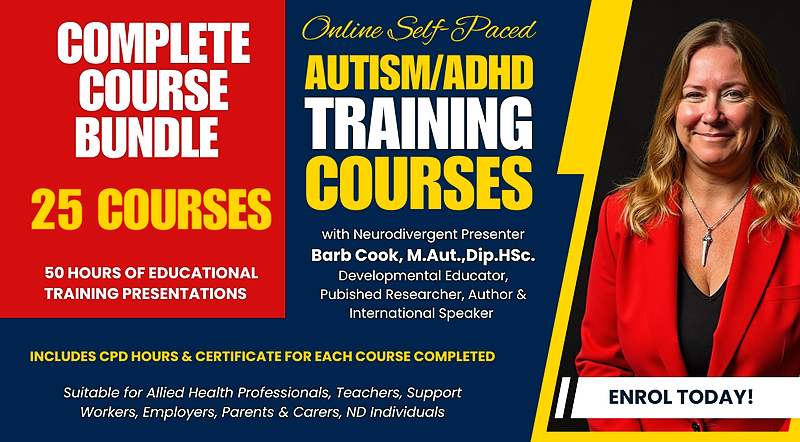
Autism ADHD PDA Course Bundle
BundleAutism/ADHD/PDA Complete Course Bundle. 50 hours of educational training presentations and resources with Barb Cook, M.Aut.,Dip.HSc., Registered Developmental Educator, NDIS Registered Specialist PBS Practitioner, Integrative Nutritionist
$599
-
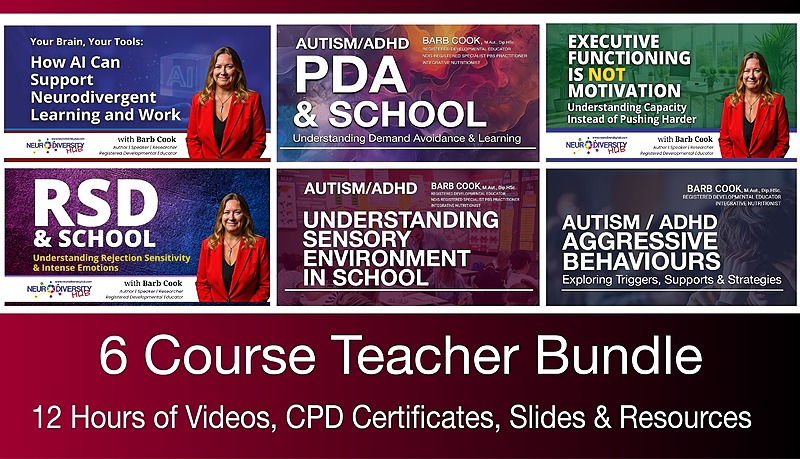
PD Education Bundle
BundleA practical training bundle for teachers covering executive functioning, RSD, PDA, AI, sensory environments and aggressive behaviours. Build confidence and neuroaffirming strategies to better support autistic and ADHD learners in the classroom.
$245
About the Presenter

Barb Cook, M.Aut.(Ed), Dip.HSc.(Nut)
Registered Developmental Educator, NDIS Registered Specialist Level Positive Behaviour Support Practitioner, Integrative Nutritionist & Specialist Neurodiversity Employment Consultant
Barb Cook is a registered Developmental Educator, past Deputy Chair of the Developmental Educators Australia Incorporated (DEAI), NDIS registered Specialist Level Positive Behaviour Support Practitioner, an Integrative Nutritionist, an Adult ADHD Coach and a Specialist Neurodiversity Employment Consultant for business.
Barb identifies a neurodivergent after being diagnosed mid-life (40) and after significant burnout in 2009 with autism, ADHD, and dyslexia. She is a highly committed autistic and neurodiversity advocate, writer, editor, and highly sought-after international speaker. She has made appearances on Australian radio and television, in newspapers and magazines, and in the SBS television documentary The Chameleons: Women with Autism.
Barb holds a Master of Autism degree (education) from the University of Wollongong where she was also a researcher and co-project lead in the area of self-determination and self-advocacy for autistics adults.
Barb takes a holistic approach in working with autistic/ADHD people and is dedicated to improving the overall well-being and quality of life for neurodivergent people. She is currently engaged in multiple research projects in the USA including a five year study on A Comparison of Two Brief Suicide Prevention Interventions Tailored for Youth on the Autism Spectrum, Comparing Cognitive-Behavioural Therapy versus Mindfulness-Based Therapy for Autistic Adults, and autism and ageing.
Barb is internationally recognised for her bestselling book on autism in women, Spectrum Women: Walking to the Beat of Autism with Dr Michelle Garnett, filling the gap in literature between lived experience of autistic women and the clinical knowledge. Barb’s second best-selling book co-authored with Yenn Purkis, The Autism and Neurodiversity Self-Advocacy Handbook: Developing Skills to Determine Your Own Future, is an essential guidebook that gives you the tools and strategies to advocate for yourself in any situation, developing your skills in standing up for yourself, your needs and wishes. Barb's third book, Planning Your Career Through Intense Interests is focused on assisting young autistic adults in navigating careers pathways.
Barb is founder of Spectrum Women Magazine and is a prolific writer on autism, ADHD and neurodivergence.
Barb is a highly sought-after international speaker and presents on a variety of topics related to women, autism, ADHD and Neurodiversity. Barb spoke at the World Autism Organisation Congress 2018 in Houston Texas, in 2019 she was invited by the United States government to keynote a special event “A Woman’s Voice: Understanding Autistic Needs” for the National Institute of Mental Health (NIHM) in Washington DC, USA and 2024 spoke with Dr Temple Grandin, Dr Rebecca Evanko and Taylor Heaton in Albuquerque, New Mexico USA at AutFest on autistic women.
Barb was awarded the “A Different Brilliant” award at the Aspect National Recognition Awards in Sydney and the Leadership Support Award from the Neurodiversity Academy in 2021. In 2017 she received a Special Commendation from Queensland’s Governor, his Excellency, Paul De Jersey for the Autism Queensland Creative Futures Awards.
Barb is a passionate motorcyclist, and enjoys roller skating and roller blading at an outdoor rink near her home that assists her with good self-care and is an effective anxiety reducing and depression busting practice.
Visit www.neurodiversityhub.com/barb-cook/ and www.barbcook.com.au to learn more about Barb Cook.
Published research:
29 August 2024: Brief Report: Under-Identification of Symptomatic Menopause in Public-Insured Autistic People. Teal W. Benevides, Barb Cook, Laura G. Klinger, Kiley J. McLean, Gregory L. Wallace, Meghan E. Carey, Wei-Lin Lee, Jonas Ventimiglia, Lauren D. Schiff and Lindsay Shea. Journal of Autism and Developmental Disorders. doi.org/10.1007/s10803-024-06516-x https://link.springer.com/article/10.1007/s10803-024-06516-x
19 May 2020: Listening to the autistic voice: Mental health priorities to guide research and practice in autism from a stakeholder-driven project. Teal W Benevides, Stephen Shore, May-Lynn Andresen, Barb Cook, Steven S. Coughlin, Dena L Gassner, Becca Lory Hector, and Lisa Morgan. Sage Journals: Autism doi.org/10.1177/1362361320908410 https://journals.sagepub.com/doi/full/10.1177/1362361320908410
11 May 2020: Interventions to address health outcomes among autistic adults: A systematic review. Teal W. Benevides, Stephen Shore, May-Lynn Andresen, Reid Caplan, Barb Cook, Dena L Gassner, Jasmine M Erves, Taylor M Hazlewood, M Caroline King, Lisa Morgan, Lauren E Murphy, Yenn Purkis, Brigid Rankowski, Sarah M Rutledge, Savannah P Welch and Karl Wittig. Sage Journals: Autism. doi.org/10.1177/1362361320913664 https://journals.sagepub.com/doi/full/10.1177/1362361320913664


